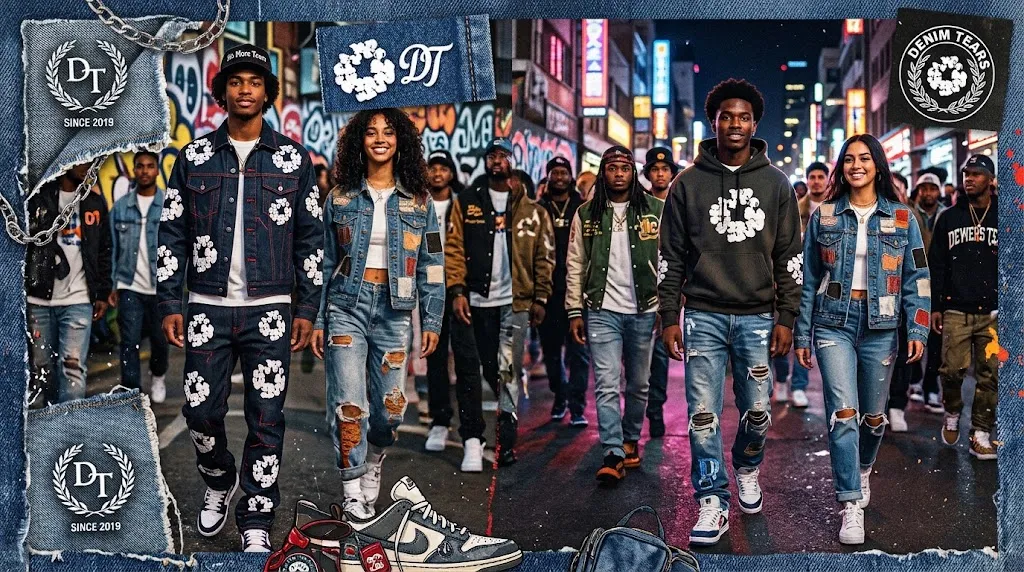
When Tremaine Emory launched Denim Tears in 2019, streetwear was already saturated with logos, hype drops, and collaborations that felt increasingly hollow. What Emory introduced was something different: a brand that used the visual language of streetwear—hoodies, denim, graphic tees—to tell a story that the industry had largely ignored. That story was the history of the African diaspora, told through a single, haunting symbol: the cotton wreath. Six years later, Denim Tears has not only become one of the most commercially successful independent labels in streetwear, but it has fundamentally shifted what the genre can be about and who it can speak to.
The Cotton Wreath: A Symbol That Changed the Conversation
The cotton wreath is deceptively simple. A circular arrangement of cotton bolls, rendered in white against denim or black fabric, it looks at first like a traditional decorative motif. But its meaning is layered and deliberate. Emory introduced the symbol in 2020, inspired in part by a photograph shared by artist Kara Walker . For Emory, the wreath represents the history of slavery and the forced labor of Black Americans in cotton cultivation, transforming a symbol of pain into something that could be worn, seen, and discussed .
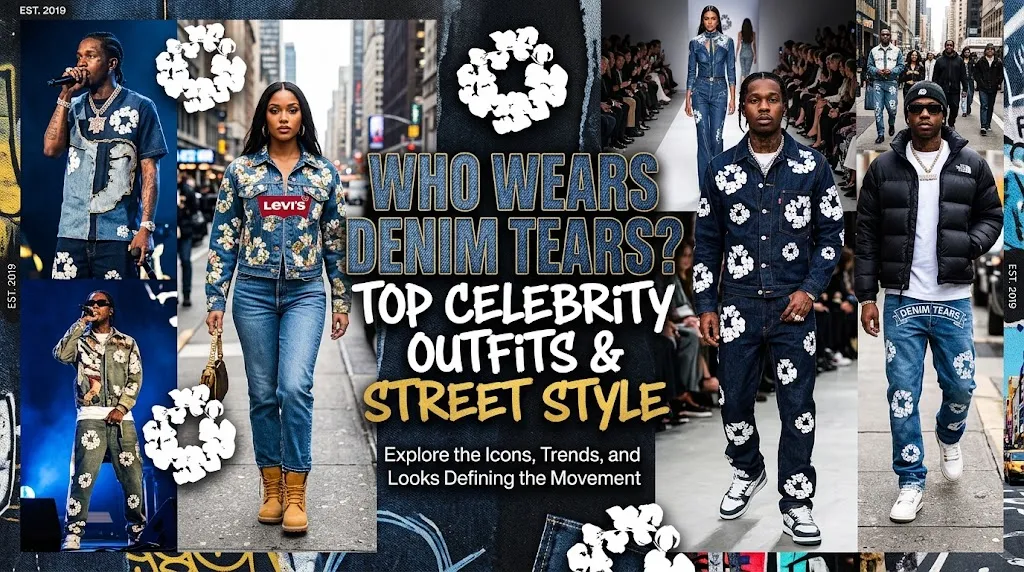
What made the cotton wreath impactful was not just its meaning but its ubiquity. Emory applied it to hoodies, sweatpants, denim jackets, and jeans through a partnership with Levi’s, making the symbol impossible to ignore in streetwear spaces . Unlike a slogan tee that delivers a message in plain text, the wreath required people to ask questions. What does it mean? Why cotton? Who made this? That curiosity became part of the brand’s power. Emory has said that even when the symbol is bootlegged or worn by someone who doesn’t know its history, it still functions as a “billboard for the message” . The symbol persists whether or not its meaning is understood, and that persistence is precisely the point.
From Hype to History: How Denim Tears Broke the Streetwear Mold
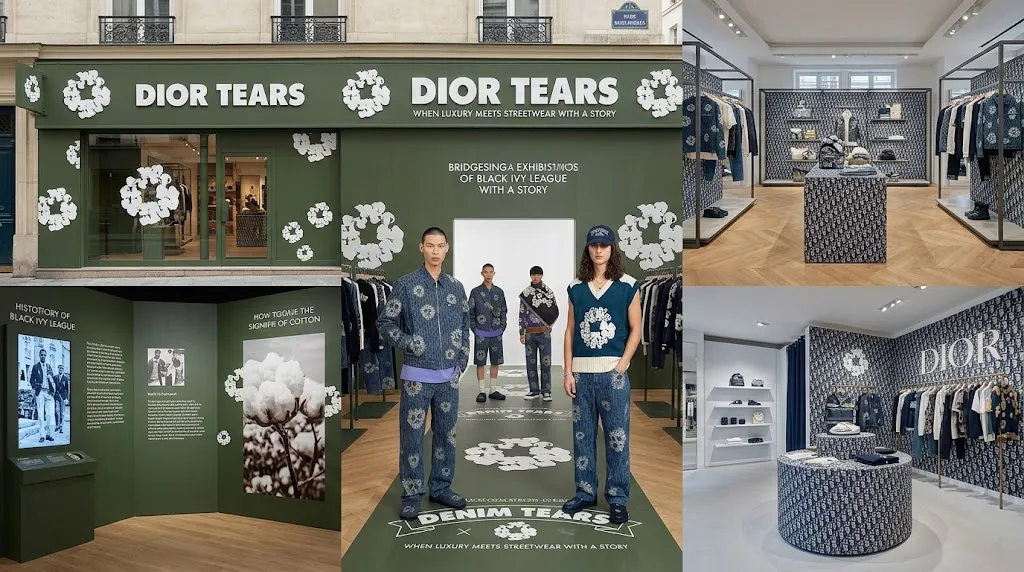
Most streetwear brands built in the 2010s followed a familiar trajectory: generate hype through scarcity, collaborate with luxury houses, expand into a lifestyle brand. Denim Tears Clothing did follow some of these steps—collaborations with Dior, Stüssy, Comme des Garçons, and Levi’s certainly raised its profile . But the brand’s foundation was never hype for hype’s sake. Emory described Denim Tears as “African American sportswear,” a label that treated garments as vehicles for historical narrative rather than mere aesthetic objects .
This approach had tangible consequences. Denim Tears generated “tens of millions” in annual revenue without any investors, doubled sales every year since its founding, and operated with only one retail partner for years before expanding its own stores . On the resale market, Denim Tears items grew 290 percent in sales in 2024 alone, and products sold for an average of 31 percent above retail in the first half of 2025 . These numbers matter because they demonstrate that substance—not just style—can drive commercial success in streetwear. The brand proved that a young audience hungry for meaning would pay for clothing that engaged with difficult history, provided the execution was sharp enough to stand on its own.
The Museum Wall and the Street Corner
Perhaps the clearest evidence of Denim Tears’ impact is its acceptance into cultural institutions that have traditionally kept streetwear at arm’s length. Garments featuring the cotton wreath are now part of the permanent collection at the Metropolitan Museum of Art’s Costume Institute, featured in exhibitions including “Superfine: Tailoring Black Style” and “America: A Lexicon in Fashion” . In 2026, the SCAD Museum of Art opened “Denim Tears from the Pool of Black Genius,” the first solo retrospective dedicated to Emory’s work, placing his garments alongside works by artists like Romare Bearden, Faith Ringgold, and Arthur Jafa .
This institutional recognition is significant not because museums validate streetwear—that debate is tired—but because it confirms that Denim Tear Clothing operates in a different register than most of its peers. Emory has consistently described his work as conceptual art delivered through clothing, a Trojan horse designed to reach people who might never set foot in a gallery . When a teenager in Queens or a stockbroker in Tokyo wears a cotton wreath hoodie, they are carrying a fragment of Black American history into spaces where that history is rarely discussed. The museum exhibition simply makes explicit what the garments have been doing all along.
Controversy, Criticism, and the Question of Commodification
No honest assessment of Denim Tears can ignore the criticism the brand has faced. Emory’s tenure as Supreme’s first named creative director ended abruptly in 2023 after he alleged systemic racism and a lack of transparency at the company, particularly regarding his desire to use images by Arthur Jafa depicting lynching and whip scarring on Supreme products . The dispute sparked a broader conversation about whether trauma should be used as a commercial design element at all. Some critics accused Emory of exactly the commodification he claimed to oppose.
Emory’s response has been consistent: the point is not to avoid discomfort but to force a reckoning with histories that have been deliberately obscured. “When I’m making these collections, the only thing that’s provocative to me is that these things haven’t been talked about before,” he told Business of Fashion. “That’s the real provocative thing to me, the lack of knowledge” . Whether one finds this position principled or hypocritical likely depends on how one views the relationship between commerce and activism in fashion. What is undeniable is that Denim Tears has made these questions unavoidable in streetwear spaces that once prided themselves on political neutrality.
Expanding the Blueprint: What Denim Tears Means for the Next Generation
The brand’s influence can be measured in the copycats and successors it has inspired. A wave of young labels now attempt to pair streetwear silhouettes with historical or political messaging, some with genuine research behind them and some with slogans slapped onto blanks. The difference between Denim Tear and its imitators lies in the depth of Emory’s engagement. Each collection is built around a specific historical framework: the cotton economy, the symbolism of the Statue of Liberty, the legacy of André Leon Talley . The research is visible in the garments, not just in the press releases.
Denim Tears also demonstrated that a Black-owned brand could operate at the highest levels of global fashion without diluting its message. Emory’s collaborations with Dior and Comme des Garçons did not require him to soften the cotton wreath or explain away its meaning; the symbol traveled intact into luxury contexts, and in doing so, it challenged the assumption that luxury spaces are somehow separate from the histories that produced their wealth . For young designers who grew up watching streetwear become a monoculture of logo swaps and celebrity endorsements, Denim Tears offered a different model: build something that means something, and the audience will find it.
Conclusion:
Denim Tears did not invent political streetwear. Brands like FUBU, Cross Colours, and even early Supreme engaged with identity and politics in their own ways. What Denim Tears did was prove that a contemporary streetwear label could be commercially viable at scale while remaining intellectually rigorous and historically grounded. The cotton wreath is now one of the most recognizable graphics in the genre, not because it was marketed aggressively but because it carried weight that consumers could feel.
The brand’s legacy is still being written. A Tokyo flagship is set to open in 2026, and Emory has launched an in-house denim program that gives Denim Tears Hoodie full control over its most important category . But whatever comes next, the foundation is solid. Denim Tears changed the terms of the conversation in streetwear. It asked the genre to grow up, to engage with the world beyond the drop calendar, and to recognize that clothing can carry history without collapsing under its weight. That is an impact that will outlast any single season’s trends.