Introduction:
In 2019, Tremaine Emory founded Denim Tears in New York, and this brand quickly became a focal point of cultural discourse in the streetwear world. Its iconic symbol “cotton wreath” is not merely a decorative pattern, but a visual declaration about the entanglement of American slavery history and the cotton industry.
When we discuss whether Denim Tears is “sustainable,” the answer is far more complex than a simple “yes” or “no.” The brand operates on multiple dimensions simultaneously: on one hand, it tells stories about history and race through its design language; on the other hand, it must face the material and ethical challenges inherent in the fashion industry. This article will analyze Denim Tears’ sustainability performance from three dimensions: environmental responsibility, social ethics, and cultural sustainability.
The History Behind Cotton:
The cotton wreath pattern is the soul of Denim Tears. According to Emory himself, the creation of this symbol stems from a profound reflection on the word “denim” itself—denim was once called “Negro cloth” and was worn by slaves, while indigo dyeing techniques were brought from Africa and executed by slaves. This history means that cotton, as the core raw material of denim, was itself an important pillar of the slavery economic system.
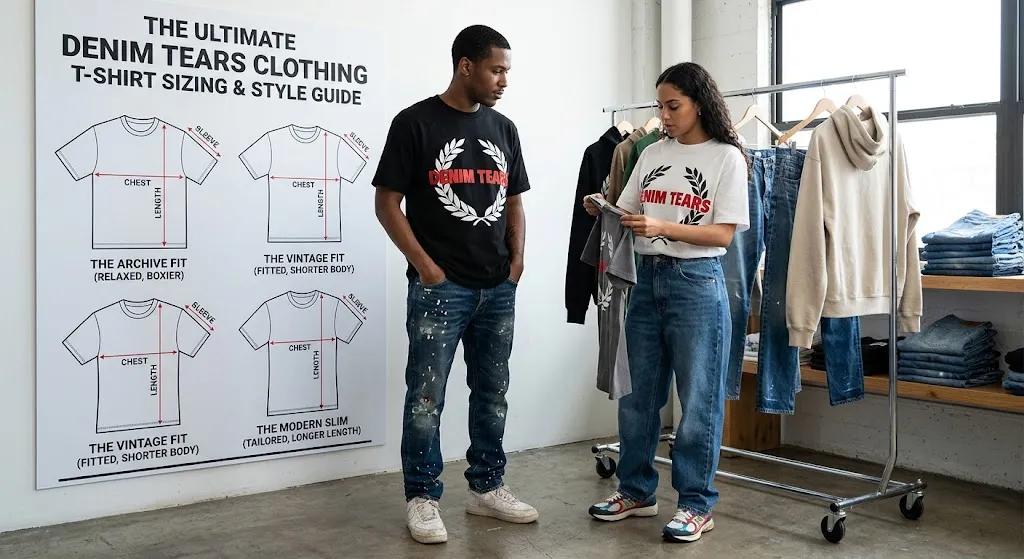
The cotton wreath appears on jeans, jackets, and sweatshirts, not as an aesthetic choice, but as a “visual mnemonic” that makes the history embedded in the material visible. Emory stated in an interview, “Every time someone wears it, there’s another chance to have a conversation”. This design strategy itself has educational significance—it compels consumers to confront the complex relationship between cotton and race.
Material Selection and Production Practices
Denim Tears’ denim production evolved over several years. Initially, the brand collaborated with Levi’s through a licensing partnership, using deadstock denim from Levi’s vintage collection. This model of using deadstock materials itself aligns with sustainable principles—it reduces the production demand for new fabrics and extends the lifespan of already-produced materials.
In December 2025, Denim Tears Hoodie launched its first fully self-operated denim line. According to multiple sources, this product line is produced and washed in the United States, collaborating with a factory described as “the cleanest denim factory in the world,” which can recycle 98% of water in the washing process. Emory stated in an interview, “I have about 30 people on my team… there are people I trust to help me select these locations”. While this claim lacks third-party certification, it reflects that the brand has sustainability considerations at the production site selection level.
It is worth noting that the new product line uses 14-ounce and 13-ounce selvedge denim produced in Japan using traditional shuttle looms. Selvedge denim is typically associated with higher durability and longer lifespan, which is a positive factor in reducing replacement frequency from a circular economy perspective.
Environmental Responsibility:
One of the most prominent environmental claims made by Denim Tears Clothing is the water recycling system in its denim washing process. The factory claims a 98% water recycling rate. If this data is accurate, it represents a significant improvement compared to traditional denim manufacturing. The traditional denim production process is notoriously water-intensive, with a single pair of jeans consuming thousands of liters of water from cotton cultivation to washing.
However, the problem lies in the lack of third-party verification of this data. There is no mention in the search results of which certification body verified this, nor is there a publicly available sustainability report. In the sustainability field, “self-declaration” and “certification verification” are two very different things.
Material Innovation and Limitations
Denim Tears has used deadstock denim and organic cotton in some collaborations. For example, in the 2021 collaboration with Our Legacy, all cutting fragments and deadstock fabrics were used, producing a fully sustainable series. This way of using “waste” as a resource reduces the production demand for new materials and is a recognized positive practice in the fashion industry.
However, the core product line—especially the cotton wreath denim that dominates the brand’s revenue—still primarily relies on virgin cotton. Cotton cultivation itself requires significant land, water, and chemical inputs. Unless there is explicit certification for organic or regenerative cotton, we cannot assume that the raw material composition of Denim Tears products is fundamentally different from the mainstream denim market.
Social Ethics: Labor, Supply Chain, and Business Practices
One reason Denim Tears has been praised by some observers is that Emory has expressed concern for “people” on multiple occasions—including team members and every link in the supply chain. In interviews, he emphasized the importance of understanding “how people are treated, how clothes are produced, and the quality”.
This level of awareness is commendable in the streetwear field, but the level of awareness and the level of practice are two different things. There is no publicly available information in the search results indicating whether Denim Tears’ supply chain has undergone any social responsibility audits, nor whether workers have collective bargaining rights or living wages. The brand’s manufacturing is concentrated in the United States and Japan, both of which have relatively complete labor laws, but the actual working conditions still require more specific information to evaluate.
Business Model and Accessibility
Denim Tears’ pricing is high. According to reports, the brand’s annual revenue reaches the “tens of millions of dollars” level, and sales have doubled every year since its establishment. Its product line includes cashmere sweatshirts worth $2,800 and limited-edition items that resell for many times the original price on the secondary market.
From a sustainability perspective, this raises a potential paradox: high-priced limited editions create a certain “resource-intensive” consumption logic—products are seen as collections and symbols rather than everyday clothing. While high prices can signal quality and durability, they can also encourage “buy to hold” rather than “buy to use” consumption behavior. Emory himself has acknowledged the impact of the resale market, where Denim Tears products sold for an average of 31% above retail price in the first half of 2025, indicating that this product still retains its value in circulation, which is a positive signal from a circular economy perspective.
Cultural Sustainability:
Denim Tears’ cultural value lies in its determination to tell the histories that have been erased by mainstream narratives. The brand’s mission, as stated on its official website, is to “uncover overlooked but highly influential narratives that are central to the Black American experience”. From this perspective, Denim Tear is not just a clothing brand, but a cultural practice platform.
However, this also brings risks. In 2023, Emory’s collaboration with Supreme was shelved because it involved a T-shirt printed with images of lynching and the scarred back of an enslaved person. This incident sparked a complex discussion: Is the visualization of traumatic history liberation or commodification? For Black American consumers, is seeing these images on clothing empowerment or exploitation?
These issues do not have simple answers. But they indicate that cultural sustainability is not just about “telling the story,” but about who is telling it, to whom, and what the purpose is. Emory responded to criticism by saying, “The only provocative thing is that these things have never been discussed before”. This perspective has a rationale, but it cannot exempt the brand from the ethical responsibility that comes with visual representation.
Conclusion:
Returning to the core question: Is Denim Tears sustainable fashion?
The answer is: it has made meaningful progress in some areas, but it cannot yet be called a “fully sustainable” brand.
The brand has shown awareness in reducing water consumption, using deadstock materials, and considering supply chain ethics. Its cultural mission—centering Black history in fashion discourse—is itself a form of sustainability: ensuring that the stories behind clothing are not forgotten.
But there are still gaps. Lack of third-party certification, insufficient public transparency in the supply chain, and the sustainability nature of core product materials all need more evidence. The brand has not published a comprehensive sustainability report, nor has it set publicly verifiable environmental targets.
For consumers, the meaningful question might not be “Is Denim Tears sustainable,” but rather “What am I supporting when I buy Denim Tears?” If what you value is a brand willing to take a stand on racial history and has made improvements at the production level, then Denim Tears offers something different from most streetwear brands. If you need concrete proof of a brand’s environmental and social performance, Denim Tears has not yet reached that level of transparency.
The sustainability of fashion is ultimately a process, not a destination. Denim Tears is moving in a positive direction, but the distance remains.