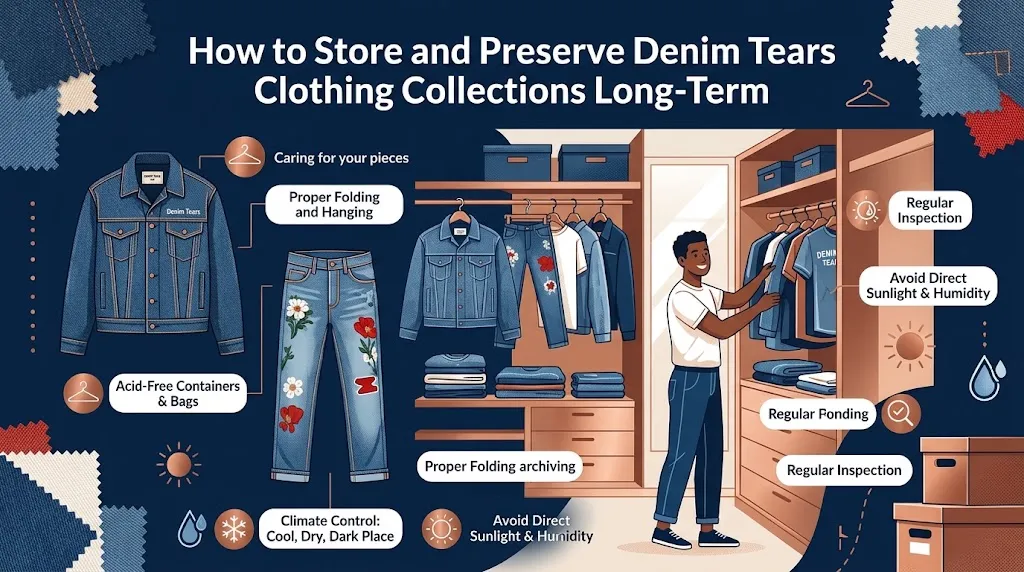
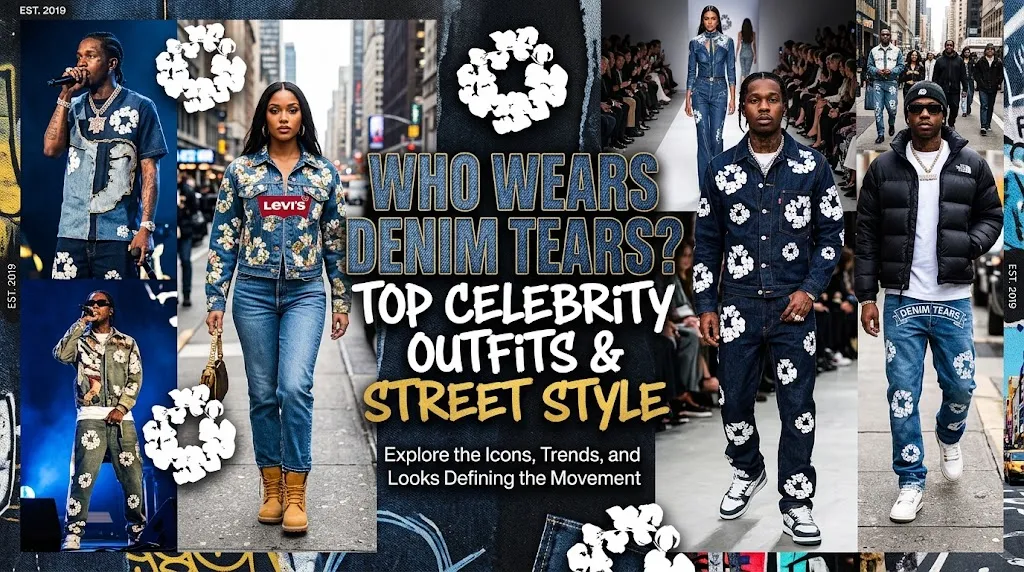
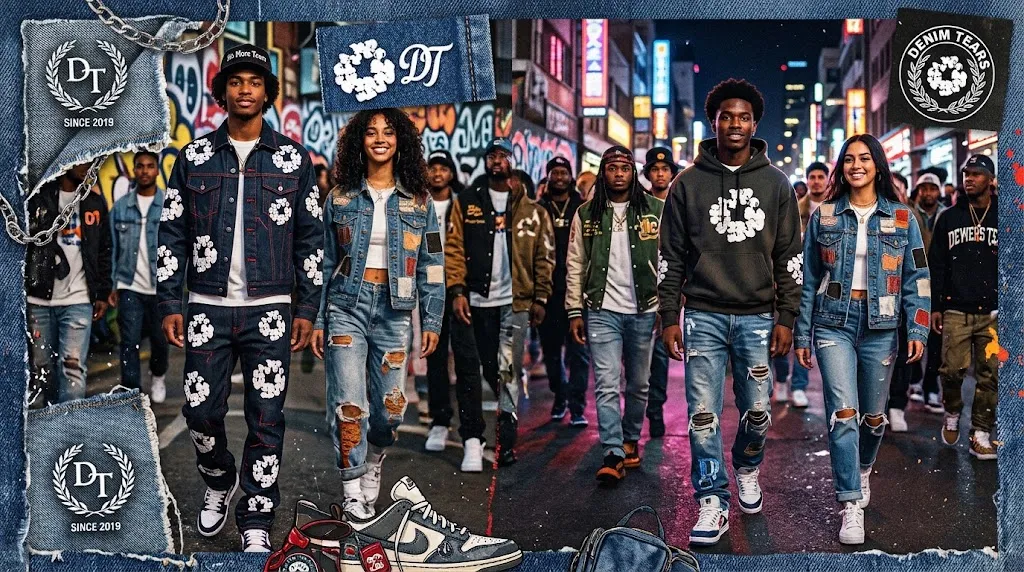
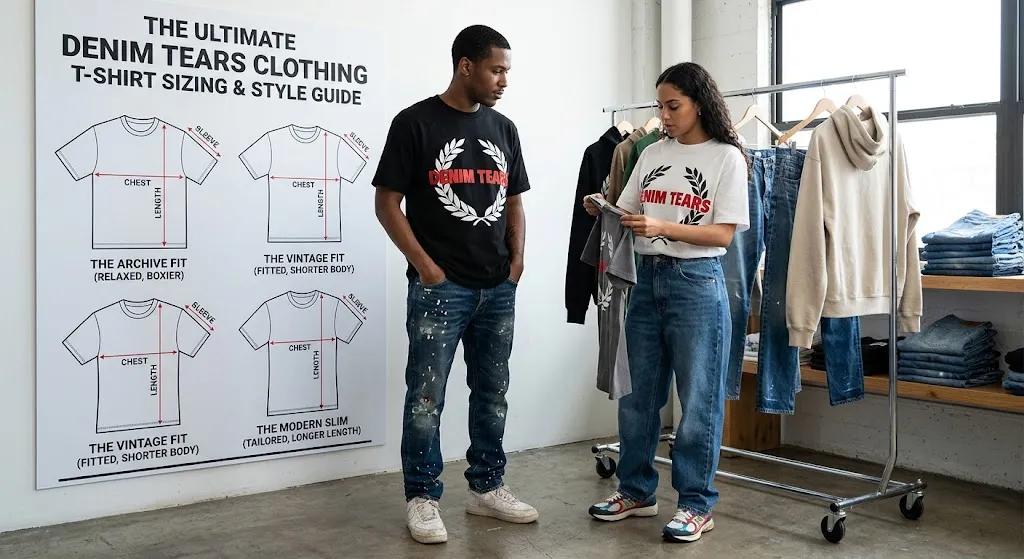
When Tremaine Emory returned to the United States in 2019 after nearly a decade in London, he did not come back to comfort. He came back to a country that felt different from the one he left. Barack Obama was no longer president. Donald Trump was. What Emory saw around him—both online and in person—made him want to respond. He considered making art for galleries, but he knew that route would not reach the people he wanted to speak to. So he chose clothing instead. That decision became Denim Tears, a brand that has since grown from a personal reaction into one of the most culturally significant labels in contemporary fashion .
The Birth of a Brand Rooted in History
Denim Tears launched in 2019, a year that carried its own weight: it marked 400 years since the first known enslaved Africans arrived in America . From the beginning, Emory described the label as “African American sportswear” . This was not a casual tagline. It was a mission statement. Every collection would tell a story about the African Diaspora, using garments as vehicles for history that textbooks often skip.
The brand’s name itself comes from a deeply personal place. Emory owned a pair of Levi’s 501 jeans that were so worn and distressed that his late friend Virgil Abloh joked they looked like they were crying. That pair of jeans, and the joke that followed, gave birth to the name Denim Tears CLothing . It is a small origin story with a much larger meaning: a brand built on wear, tear, and the visible marks of lived experience.
The Cotton Wreath: A Symbol That Changed Everything
If Denim Tears has a visual language, its central word is the cotton wreath. Emory first encountered the motif through a photograph that artist Kara Walker shared on Instagram. He sought out a wreath of his own, and eventually transformed the image into the brand’s defining emblem . The wreath is made of cotton flowers, and it carries a deliberate, uncomfortable reference: the cotton plant was the crop around which slavery was built in America, and the forced labor of enslaved Black people made cotton one of the most profitable industries in the world .
What makes the cotton wreath powerful is not just what it represents, but how Emory uses it. It appears on denim jackets, hoodies, jeans, and sweatpants. It is rendered in screen prints, embroidery, and even crystal embellishments. By placing this symbol on everyday clothing, Emory turns a history of pain into something people wear on their bodies. The wreath becomes a memorial, a reclamation, and a quiet argument about what American history should be remembered .
The Levi’s Collaboration That Put Denim Tears on the Map
Denim Tears might have remained a niche project if not for a pivotal collaboration. In 2020, the brand partnered with Levi’s on a collection that covered the Trucker Jacket, the 501 jean, and a Plantation Hat with an all-over white cotton wreath print . The pieces were an immediate success. They became the brand’s most recognizable products and are still released in new washes and variations years later .
This collaboration did more than sell clothes. It demonstrated that Emory’s approach—using a historic American garment like denim as a canvas for Black history—could work commercially without watering down the message. Denim, after all, is not a neutral fabric. It is the uniform of American work, and its history is tangled with the labor of enslaved people. Emory understood that using denim to tell this story was not just aesthetic. It was logical.
Building a Business Without Investors
In an era when many fashion brands chase venture capital and rapid expansion, Denim Tears grew differently. According to reports, the brand reached “tens of millions” in annual revenue and doubled its sales every year since its founding, all without outside investors and with only one retail partner, Dover Street Market, where it sold through a concession model . For a brand with almost no traditional retail distribution, its presence on the resale market became a measure of its cultural heat. On StockX, sales of Denim Tears items grew 290 percent in 2024 compared to the previous year, and in the first half of 2025, products sold for an average of 31 percent above retail .
This kind of demand is not just about hype. It reflects a customer base that wants to wear something with meaning. As Jonathan M. Square, an assistant professor of Black visual culture at Parsons School of Design and a Denim Tears customer, put it: “We’re in a moment where people want to support a project and a brand that’s aligned with their values” . Denim Tears offered exactly that.
When Fashion Enters the Museum
The ultimate validation that Denim Tears had moved beyond streetwear came from the art world. In 2021, the brand’s Tyson Beckford sweater—a reinterpretation of a classic Ralph Lauren knit that replaced the American flag with David Hammons’ “Untitled (African-American Flag)”—was included in the Metropolitan Museum of Art’s Costume Institute exhibition “America: A Lexicon of Fashion.” The following year, The Met acquired three Denim Tears pieces for its permanent collection, including the Tyson Beckford sweater, a Levi’s ensemble, and a pair of UGG slippers .
Then, in 2026, the Savannah College of Art and Design Museum of Art opened “Denim Tears from the Pool of Black Genius,” Emory’s first solo exhibition. The show placed Denim Tears garments alongside works by Black artists who inspired him, including Romare Bearden, William H. Johnson, Faith Ringgold, and Charles White. Sixteen scarecrows, each dressed in pieces from different Denim Tears collections, stood in a circle in the main room—a visual confrontation with the legacy of Jim Crow . Emory described the exhibition as “seven years of Denim Tears” but also “45 years of my life” . The clothes had become artifacts, and the brand had become a body of work.
The Stories Behind the Collections
What separates Denim Tear from brands that simply print slogans on hoodies is the depth of research and narrative behind each release. Take the Spring/Summer 2026 collection, “Libertas.” Emory built the collection around the true history of the Statue of Liberty, which was originally designed by a French abolitionist to celebrate the end of slavery. In the original version, the statue held broken shackles. The American government rejected that design and forced a revision, but the sculptor clandestinely moved the shackles to the statue’s feet, where they remain nearly invisible from the ground . Emory translated this story into garments, including a leather jacket depicting Lady Libertas with the shackle she should have been holding, reimagined with the face of a Black woman .
This is the pattern across Denim Tears collections. Emory does not design around trends. He designs around stories that have been obscured, forgotten, or deliberately hidden. As he told Highsnobiety: “There are a million choices to make when you’re making clothes, that’s why I love the anchor of a story. It helps really narrow down the choices” .
The Controversies and the Conviction
Emory’s path has not been without conflict. In 2023, he stepped down from his role as creative director of Supreme after just eighteen months, alleging that “systematic racism was at play within the structure of Supreme.” He said the rift occurred partly because he was prevented from using images by artist Arthur Jafa—one showing a Black man being lynched, another depicting whip scars on the back of a freed slave—on Supreme apparel . Some criticized Emory for what they saw as the commercialization of Black trauma. But Emory has consistently rejected the idea that his work is intentionally provocative. “When I’m making these collections, the only thing that’s provocative to me is that these things haven’t been talked about before,” he said. “That’s the real provocative thing to me, the lack of knowledge” .
This conviction is what makes Denim Tear Clothing difficult to dismiss. The brand is not selling outrage. It is selling education, wrapped in garments people actually want to wear. The cotton wreath is not a shock tactic. It is a reminder. The denim is not just fabric. It is a material with a history, and Emory refuses to let that history stay buried.
What Denim Tears Means for Black Fashion
Denim Tears did not emerge in a vacuum. It arrived at a moment when conversations about race, history, and representation were happening loudly in fashion and beyond. But Emory’s contribution is distinct. He did not simply create a Black-owned brand that catered to Black consumers. He created a brand that used the tools of American sportswear—denim, sweatshirts, T-shirts, varsity jackets—to tell Black American stories to anyone willing to pay attention. The clothes are accessible in form, but demanding in content.
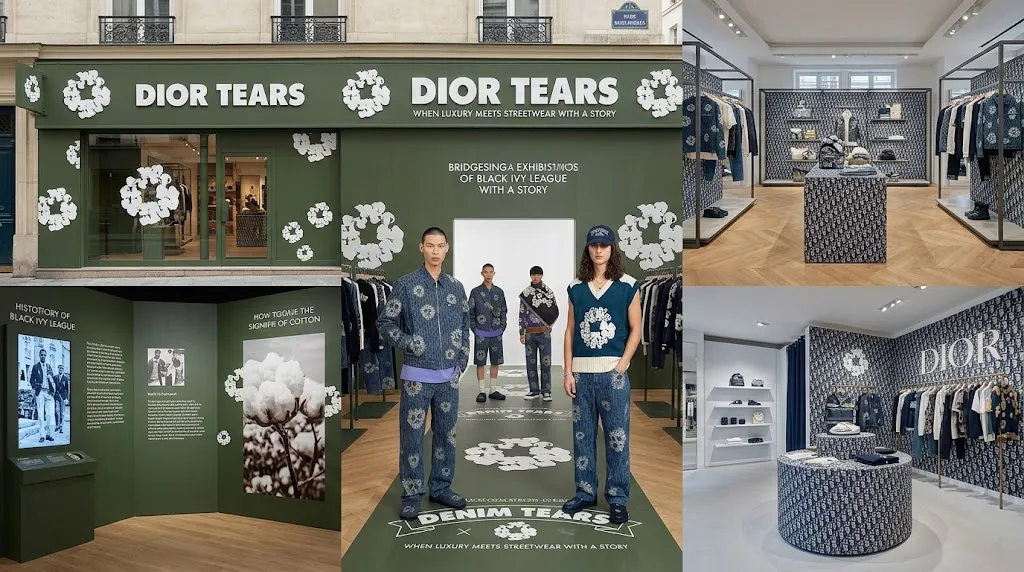
The brand’s presence in The Met’s permanent collection, its solo exhibition at SCAD, and its consistent sell-out collaborations with everyone from Levi’s to Dior to UGG all point to the same conclusion: Denim Tears has changed what a streetwear brand can be. It can be a business. It can be a museum piece. It can be a history lesson. And it can be all of those things at once, without apology.
Emory once said that he would be making art if he didn’t feel clothing was a more efficient way of spreading a message . Denim Tears is the proof that he chose correctly. A gallery might reach hundreds of people. A hoodie with a cotton wreath reaches thousands. And a brand built on stories that refuse to be forgotten reaches further still.